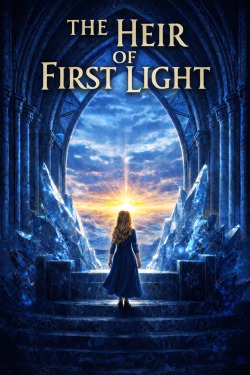
I hope you like it...
The Heir of First Light At the dawn of creation, light was not meant to last forever. Born from the first spark of existence, the world of Celestria was shaped by wonder, balance, and a quiet covenant: power was never meant to rule, only to guide. But as ages passed...

www.scribblehub.com
Where Light Was Born
Before anything existed, before light, before warmth, before even the concept of time, there was nothing. No sound, no shape, only an endless void, silent and still, stretching beyond comprehension.
From that void, a presence stirred, awakening with the delicate precision of a ripple from the first drop of rain on still water. It became aware in the impenetrable darkness, as a fragile, unformed “self” born from its thought alone.
Curiosity stirred within the nascent awareness, and something shifted where there had been nothing before.
From that shift, form emerged for the first time. The presence gathered itself from the quiet of existence, becoming something that could see, could wonder, could look outward upon the emptiness that surrounded it.
As the presence observed the void, reality answered its curiosity. A single stable pattern took hold where none had existed before, and hydrogen emerged, delicate but enduring. It gathered slowly in the dark, drawn together by forces the presence could not yet name.
As the pressure deepened, energy awakened within it. Light burst forth and endured, and the first sun was born. Its glow spilled into the void, humming with infinite promise, as though creation itself had taken its first breath.
The glow of the light yielded warmth, and warmth brought comfort. For the first time, there was more than emptiness. In that comfort, the presence understood, “I am.”
Curiosity did not fade. It lingered, watching as matter gathered and changed. Under pressure and time, simple bonds gave way to more complex ones. New elements emerged. Carbon and oxygen. Iron, dense and enduring. Vast masses of rock and metal took shape, and where conditions allowed, water formed to cool and cleanse. With it came motion, balance, and the first stirrings of vitality.
Yet even as the physical world grew in complexity, it remained silent. Light and warmth endured. Matter gathered and changed. The presence delighted in what it witnessed, but the wonder had nowhere to go.
Alone within its expanding realm, it wondered, “What is my purpose? Am I to exist in solitude for eternity?”
It searched for something. Anything else. But found nothing. It ventured toward the light but found only silence. It called out, "Am I the only one?" The sound rippled into the void and faded, swallowed by endless emptiness. Not even an echo remained. Desperate, it ventured deeper into the void's cold, reaching into the darkness itself. Again, nothing. It called out once more, "Am I the only one?"
Only solitude answered.
With that solitude came fear, not of darkness or distance, but of endless silence. The presence understood then that existence alone was not enough. To endure, it must choose to act.
And so, for the first time, it did not merely observe what was becoming. It shaped what would come next.
From thought and intention, the presence brought forth others. Not reflections of itself, but beings with their own sense of self and purpose. They awakened into difference, and in that difference, they found balance. Where they gathered, stillness gave way to motion, and the cosmos learned its first harmony. They looked to the one who had chosen to act in the darkness, and in that shared recognition, the presence became more than awareness. It became King.
Under his guidance, a realm took shape. Light endured there. Creation flourished without decay, and the silence of the void no longer pressed so close. This Kingdom was named Celestria, and it stood apart from all else, warm with purpose and bound by the first light. Its people lived not in conquest, but in curiosity, tending what had been given and seeking to understand what lay beyond their knowing.
In time, even Celestria was not enough. Beyond its borders, reality stretched outward, vast and unfinished, filled with wonders yet unseen. The King felt the pull of that unknown, not as a desire to rule it, but to learn from it. So, he set his people upon a new path. To venture outward. To explore what had been born beyond the light. To become stewards not only of a Kingdom, but of creation itself.
Ages passed, and the choice endured. What began as wonder became tradition. What was once the work of gods became the inheritance of kings and councils, carried forward by quiet hands tending the light. Celestria remained, not as a myth remembered, but as a world lived in, shaped by the same curiosity that first turned outward from the void as the weight of ages settled quietly.