It depends if you as a person/ author are speaking to the reader, or if the character is pausing the story to 4th wall break for a moment.
"Quotes represent character dialogue. Here it typically matter what you say, how you say it, and how you want to convey those words because it's the character saying it. THEIR knowledge is different from YOUR knowledge as an author."
"Words spoken can lack in clarity." (Using parentheses is generally a quick added Author's note as a small tidbit of information to help clarify what was previously said, or to aid in a bit of information) like when describing something (adding a bit more for flavor text, but is not necessarily needed. This is usually the stuff that bogs down a story with useless information, but you thought was interesting enough to add, but can also be skipped if the reader chooses.) <-- Most writer's would stay away from this entirely. If it isn't needed, doesn't change the scene, vibe, character's (or readers) perspective, it should be generally left out to begin with.
//Slashes are sometimes used as Author's notes, and are (most importantly) separated from any, and all, text(s), because it is directly from you (the author, and writer), and breaks the reader's attention. Again, most writers avoid this because when reading a story, you generally want the reader to delve into the story, and immerse themselves into the book without being reminded, "Hey, hello, sir, or madam. You are reading". (And, now, breathing manually.)
-- > Dashes are difficult because they can be added "almost-"
"Anywhere."
-And, they can even appear at the beginning of a sentence.
Most times, dashes are used between characters, whenever character A is talking but gets cut off by character B interrupting their focus.
Dashes can also be used as: Long- drawn out pauses. S-stutters. or-
Abrupt stops.
At least, this is all just from what I've learned by reading varieties of authors; I'm NOT an English major, teacher, professor, or anything of the sort. I just like books. -And I'm still learning to write myself.
For a 4th wall break (coming from a character) You don't necessarily use anything. You just tell it how it is; Unless, they are speaking, then use quotes, but again, tell it how it is.
--- >
Ex: Nazet was confused on this issue. Now, they weren't the type of person to generally get stuck on anything, but on this one issue- They did. They decided to ask the forum.
(In my own opinion) The part where I said, "Now, they weren't the type of person to generally get stuck on anything, but on this one issue- They did." Is the voice of the narrator (the reader) without breaking the story with an author's note, or TRULY breaking the 4th wall. Just within the 3 sentences, "Nazet was confused on the issue. They decided to ask the forum." <-- That's the story part, that's what most would generally write into the story; Albeit, much cleaner and less 1 - 2 ("Nazet was confused, so, they decide to ask the forum." Interchanging "so" with and, or but, or whatever junction you want as a writer etc etc.), but my point stands.
If you want some examples of other writers truly breaking the 4th wall. I'd recommend watching one of these films, and analyzing how you would write some of the scenes if they were to be written into books, or literally just pick up the book/ book series (or comics/ comic novels):
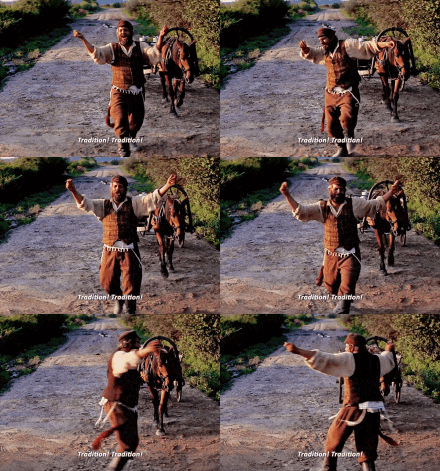
Fiddler on the Roof (1971) Chaim Topol as Teyve, the Milkman (his inner dialogues being portrayed as 4th wall breaks)
Lemony Snicket's A Series of Unfortunate Events (2004) Pay attention to Jude Law being the Narrator (when not pulling viewer attention)
Deadpool (2016) Just Ryan Reynolds being Deadpool