How can I transmit that I am talking to the reader instead of narrating the story?

Nazet

Member
Joined
Oct 15, 2025
Messages
36
Points
18
I posteda tread asking people to take a look at the last chapter released, and some of the feedback was concerned because it seemed to be generated by AI.
That's because at the end I was trying to speak directly to the reader instead of narrating the story, so I used parentheses.

So my question is, how can I speak directly to the reader in the novel without sounding like I'm narrating?

Or in this case, how can I sound natural so they don't think it's AI? Besides, I write in one language and then translate it. Because in Portuguese writing, we don't use quotation marks, dashes, and parentheses exactly as in English. And I may be making mistakes when I translate.
 

Nazet

Member
Joined
Oct 15, 2025
Messages
36
Points
18
Carefully. Read more books written in English so you know how to make yours sound natural.
okey, but what would you do in my place to convey that you are talking to the reader and not narrating?
 

laccoff_mawning

Well-known member
Joined
Oct 26, 2022
Messages
494
Points
133
I find this to be a confusing question. Narrating a story is talking to the reader. If not, who do you think you are narrating the story to?

quotation marks "" or '' are used when a fictional character is speaking.

Dashes and parenthesis are a lot rarer in novels. A dash is like a comma, but you can think of it as having a longer or more dramatic pause.

I can't think of an example of creative writing that uses parenthesis, so I'd advise you not to bother using them.
 
Last edited:

Nazet

Member
Joined
Oct 15, 2025
Messages
36
Points
18
I find this to be a confusing question. Narrating a story is talking to the reader. If not, who do you think you are narrating the story to?

Parenthesis "" or '' are used when a fictional character is speaking.

Dashes and parenthesis are a lot rarer in novels. A dash is like a comma, but you can think of it as having a longer or more dramatic pause.

I can't think of an example of creative writing that uses parenthesis, so I'd advise you not to bother using them.
wow writting is hard ?
Yeah, you right. I will keep the parentheses for foreign language translations only. As it is a story that has several people speaking different languages, I sometimes put speech in the native language to give more emphasis to personality and origin. That is why I use parentheses in first speeches to help those who do not know or in longer speeches.
Use the author's note at the end of the chapter.
yes, that works here but not everywhere. Few have an author's note.
 

Golden_Hyde

break all tropes
Joined
Jul 17, 2024
Messages
304
Points
78
Two words: which one?
if you mean through author's note, then do so through it using built-in tools in the writing space. But if you mean conveying something (usually a subtle message) without seen as breaking the 4th wall as a narrator, then you had to be careful with your wording.
 

Empress_Omnii

Gay. Girl. Gay. Girl. Gay.
Joined
Oct 13, 2023
Messages
738
Points
133
yes, that works here but not everywhere. Few have an author's note.
I also don't find your question clear, but if what you're wanting are author notes. Just label it as such. If you're on a site without them, just separate the note and the story. Be it through a line or just sticking the note a few lines down, then label it authors note.
 

CharlesEBrown

Well-known member
Joined
Jul 23, 2024
Messages
4,762
Points
158
Is your novel first person? If so, you can directly address the audience.
If not... why are you stepping out of the story to talk to the reader? This is a common thing in children's stories but not in English Language novels past the Young Adult level, for a reason - audiences often feel like you are talking down to them when you (and I mean in general, not you personally) address them like that, they feel you're saying "Of course, you can't understand my genius so I'm going to hold your hand and explain it all"

You can also get away with it in comedy - Douglas Adams did in the Hitchhiker's Guide series in quite a few places. But it is very hard to pull off well, and harder in fiction aimed at adults or a YA crowd.
 

LeilaniOtter

Well-known member
Joined
Jun 29, 2025
Messages
1,207
Points
113
Another example of "why we shouldn't use AI for writing anything."

If translation is such a chore, just find someone professional to translate for you. If you're looking for writing with feeling that is going to "sing" to your audience, you're going about it the wrong way. *^^* AI isn't going to "feel" anything.
 

CinnaSloth

ᑕIᑎᑎᗩᔕᒪᑌT💢🌶️💕🌹
Joined
Nov 20, 2024
Messages
542
Points
108
It depends if you as a person/ author are speaking to the reader, or if the character is pausing the story to 4th wall break for a moment.

"Quotes represent character dialogue. Here it typically matter what you say, how you say it, and how you want to convey those words because it's the character saying it. THEIR knowledge is different from YOUR knowledge as an author."

"Words spoken can lack in clarity." (Using parentheses is generally a quick added Author's note as a small tidbit of information to help clarify what was previously said, or to aid in a bit of information) like when describing something (adding a bit more for flavor text, but is not necessarily needed. This is usually the stuff that bogs down a story with useless information, but you thought was interesting enough to add, but can also be skipped if the reader chooses.) <-- Most writer's would stay away from this entirely. If it isn't needed, doesn't change the scene, vibe, character's (or readers) perspective, it should be generally left out to begin with.

//Slashes are sometimes used as Author's notes, and are (most importantly) separated from any, and all, text(s), because it is directly from you (the author, and writer), and breaks the reader's attention. Again, most writers avoid this because when reading a story, you generally want the reader to delve into the story, and immerse themselves into the book without being reminded, "Hey, hello, sir, or madam. You are reading". (And, now, breathing manually.)

-- > Dashes are difficult because they can be added "almost-"
"Anywhere."
-And, they can even appear at the beginning of a sentence.
Most times, dashes are used between characters, whenever character A is talking but gets cut off by character B interrupting their focus.
Dashes can also be used as: Long- drawn out pauses. S-stutters. or-
Abrupt stops.

At least, this is all just from what I've learned by reading varieties of authors; I'm NOT an English major, teacher, professor, or anything of the sort. I just like books. -And I'm still learning to write myself.

For a 4th wall break (coming from a character) You don't necessarily use anything. You just tell it how it is; Unless, they are speaking, then use quotes, but again, tell it how it is.
--- >
Ex: Nazet was confused on this issue. Now, they weren't the type of person to generally get stuck on anything, but on this one issue- They did. They decided to ask the forum.
(In my own opinion) The part where I said, "Now, they weren't the type of person to generally get stuck on anything, but on this one issue- They did." Is the voice of the narrator (the reader) without breaking the story with an author's note, or TRULY breaking the 4th wall. Just within the 3 sentences, "Nazet was confused on the issue. They decided to ask the forum." <-- That's the story part, that's what most would generally write into the story; Albeit, much cleaner and less 1 - 2 ("Nazet was confused, so, they decide to ask the forum." Interchanging "so" with and, or but, or whatever junction you want as a writer etc etc.), but my point stands.

If you want some examples of other writers truly breaking the 4th wall. I'd recommend watching one of these films, and analyzing how you would write some of the scenes if they were to be written into books, or literally just pick up the book/ book series (or comics/ comic novels):
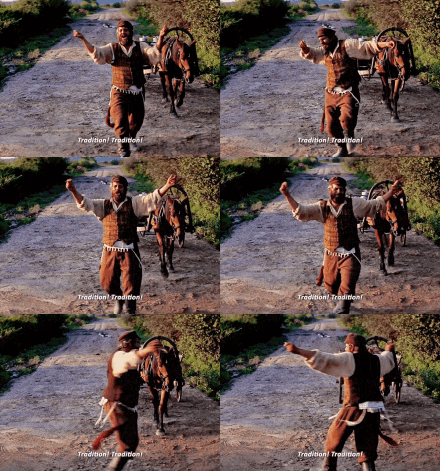
Fiddler on the Roof (1971) Chaim Topol as Teyve, the Milkman (his inner dialogues being portrayed as 4th wall breaks)
Lemony Snicket's A Series of Unfortunate Events (2004) Pay attention to Jude Law being the Narrator (when not pulling viewer attention)
Deadpool (2016) Just Ryan Reynolds being Deadpool

 
Last edited:

eternalparticle

Well-known member
Joined
Sep 5, 2025
Messages
43
Points
53
You should provide an example of what you mean, that is, where exactly do you want to step out and talk to the reader? At the very least you should link the chapter (copy pasting the paragraph always works).

I won't say it is something you shouldn't do, though most conventional writers would see this as a taboo; who knows you might end up writing in an oddly unique way of narrating a story which only selectively works.

Then again, provide more context. As many (me included) are confused by what you mean. Do you want to talk to the readers as in "What would you do if you were in xyz's shoes"..? then we have author's notes, and in case it's a narrating style (like breaking the 4th wall stuff) then it's a completely different story...

Make it easier for people to help you!! :blob_melt:
 

Nazet

Member
Joined
Oct 15, 2025
Messages
36
Points
18
It depends if you as a person/ author are speaking to the reader, or if the character is pausing the story to 4th wall break for a moment.

"Quotes represent character dialogue. Here it typically matter what you say, how you say it, and how you want to convey those words because it's the character saying it. THEIR knowledge is different from YOUR knowledge as an author."

"Words spoken can lack in clarity." (Using parentheses is generally a quick added Author's note as a small tidbit of information to help clarify what was previously said, or to aid in a bit of information) like when describing something (adding a bit more for flavor text, but is not necessarily needed. This is usually the stuff that bogs down a story with useless information, but you thought was interesting enough to add, but can also be skipped if the reader chooses.) <-- Most writer's would stay away from this entirely. If it isn't needed, doesn't change the scene, vibe, character's (or readers) perspective, it should be generally left out to begin with.

//Slashes are sometimes used as Author's notes, and are (most importantly) separated from any, and all, text(s), because it is directly from you (the author, and writer), and breaks the reader's attention. Again, most writers avoid this because when reading a story, you generally want the reader to delve into the story, and immerse themselves into the book without being reminded, "Hey, hello, sir, or madam. You are reading". (And, now, breathing manually.)

-- > Dashes are difficult because they can be added "almost-"
"Anywhere."
-And, they can even appear at the beginning of a sentence.
Most times, dashes are used between characters, whenever character A is talking but gets cut off by character B interrupting their focus.
Dashes can also be used as: Long- drawn out pauses. S-stutters. or-
Abrupt stops.

At least, this is all just from what I've learned by reading varieties of authors; I'm NOT an English major, teacher, professor, or anything of the sort. I just like books. -And I'm still learning to write myself.

For a 4th wall break (coming from a character) You don't necessarily use anything. You just tell it how it is; Unless, they are speaking, then use quotes, but again, tell it how it is.
--- >
Ex: Nazet was confused on this issue. Now, they weren't the type of person to generally get stuck on anything, but on this one issue- They did. They decided to ask the forum.
(In my own opinion) The part where I said, "Now, they weren't the type of person to generally get stuck on anything, but on this one issue- They did." Is the voice of the narrator (the reader) without breaking the story with an author's note, or TRULY breaking the 4th wall. Just within the 3 sentences, "Nazet was confused on the issue. They decided to ask the forum." <-- That's the story part, that's what most would generally write into the story; Albeit, much cleaner and less 1 - 2 ("Nazet was confused, so, they decide to ask the forum." Interchanging "so" with and, or but, or whatever junction you want as a writer etc etc.), but my point stands.

If you want some examples of other writers truly breaking the 4th wall. I'd recommend watching one of these films, and analyzing how you would write some of the scenes if they were to be written into books, or literally just pick up the book/ book series (or comics/ comic novels):
Fiddler on the Roof (1971) Chaim Topol as Teyve, the Milkman (his inner dialogues being portrayed as 4th wall breaks)
Lemony Snicket's A Series of Unfortunate Events (2004) Pay attention to Jude Law being the Narrator (when not pulling viewer attention)
Deadpool (2016) Just Ryan Reynolds being Deadpool
You're amazing! ?
I'll use what you shared with me to improve my writing.
Honestly, thank you so much!
I hope you have a great day!
You should provide an example of what you mean, that is, where exactly do you want to step out and talk to the reader? At the very least you should link the chapter (copy pasting the paragraph always works).

I won't say it is something you shouldn't do, though most conventional writers would see this as a taboo; who knows you might end up writing in an oddly unique way of narrating a story which only selectively works.

Then again, provide more context. As many (me included) are confused by what you mean. Do you want to talk to the readers as in "What would you do if you were in xyz's shoes"..? then we have author's notes, and in case it's a narrating style (like breaking the 4th wall stuff) then it's a completely different story...

Make it easier for people to help you!! :blob_melt:
Is okay, i already figured it out.
But you guys are really amazing, everyone is trying to help.
Thank you so much! :blob_happy:
 

Representing_Tromba

Sleep deprived mess of an author begging for feedb
Joined
Jan 29, 2020
Messages
5,988
Points
233
Identify the reader first as someone you, the author, are talking to. Perhaps a "Hello there" would suffice, but acknowledging the reader first is key.
 

CharlesEBrown

Well-known member
Joined
Jul 23, 2024
Messages
4,762
Points
158
Lemony Snicket's A Series of Unfortunate Events (2004) Pay attention to Jude Law being the Narrator (when not pulling viewer attention)
The TV series on Netflix did a good job with this too, with Patrick Wharburton (sp?). Haven't read the books, but I believe those moments are present there as well, opening with a note like "Gentle reader," "dear friend," "I am sorry for breaking in like this, old friend, but..."
 
Top