
You are using an out of date browser. It may not display this or other websites correctly.
You should upgrade or use an alternative browser.
You should upgrade or use an alternative browser.
I wrote the best of the best (I'm not exaggerating). Do you want to criticize it?
- Thread starter The.AZ
- Start date
I've already seen threads explaining how to do it, but I haven't been able to.You need to link it
I guess I'm a bit of a noob when it comes to these websites.

Kurayami
Pink Witchpire
- Joined
- Nov 10, 2025
- Messages
- 108
- Points
- 93
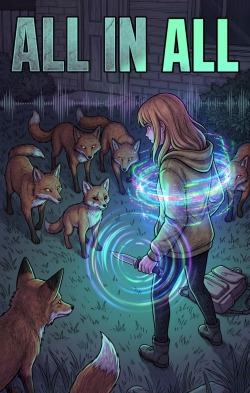
All in All
Save or abandon, he will decide. Allen... what are you hiding from us? (+500,000 words) In a world that should have been just like our own, reality is being altered and reshaped by mysterious powers of different origins. Power manifests not only in abilities, but also in ideals that can be...


Ellie_in_Pink
Member
- Joined
- Aug 2, 2025
- Messages
- 40
- Points
- 18
Okay ... so the title of this post was ... strange. But I respect the hustle of trying to rage people into useful feedback. Though it probably won't generate a lot of positive attention.
First issue, you need to choose a narration style. You open in the third-person but then immediately swap over to first-person narration in italics. You kind of need to pick one narrator (either the invisible one floating over the room, or the protagonist). Because all the switching gives tonal whiplash.
If you choose a third-person narrator, then you need to work on making the protagonist's inner dialogue a bit less stilted. When you read someone's thoughts, they're not supposed to sound like they are trying to write a novel. Never have woken up thinking in the cadence of, "I'll admit it, my parents were a dysfunctional couple. I still remembered when my father would hit my mother… only for both of them, after everything, to end up crying in each other's arms. Despite all those incidents, they always made sure I wasn't around to see it. But how could I not hear it?"
Those aren't inner thoughts. They don't sound or feel like inner thoughts. They're literary narration.
Second, you need to cut a lot of exposition. Like: "It had started a few months ago. One day it simply… appeared. It was during a plane trip that she caught her first glimpse. The sun was hitting the windows and she was watching the clouds without thinking about anything in particular, when suddenly she saw it piercing through them from below upward, motionless and enormous. She almost had a heart attack thinking they were going to crash into it."
Show, don't tell. Either show us the event or let the information be filled naturally by the plot.
As you may be able to tell, I'm commenting as I read along. The aforementioned exposition suddenly turns into the full-on scene that you've already spoiled for us through the exposition. But my question is, if you're already going to show us how the tower appeared, then why isn't that the opening of the story? That would be a far better an opening hook than anything that came before it.
After that, we go back to more summarized exposition about some Luke guy. The exposition is a problem. But the bigger one is that you slip with no warning in and out of them. So I never really have a sense of whether weeks are passing, minutes, seconds. One minute, I'm being told something long ago, and the next minute I'm right back in the protagonist's thoughts. You have to think of this like a movie. You can't just jump all over the place, and expect the reader to enjoy being dragged around. You need to take your time, show the things that matter, give the protagonist room for their inner dialog.
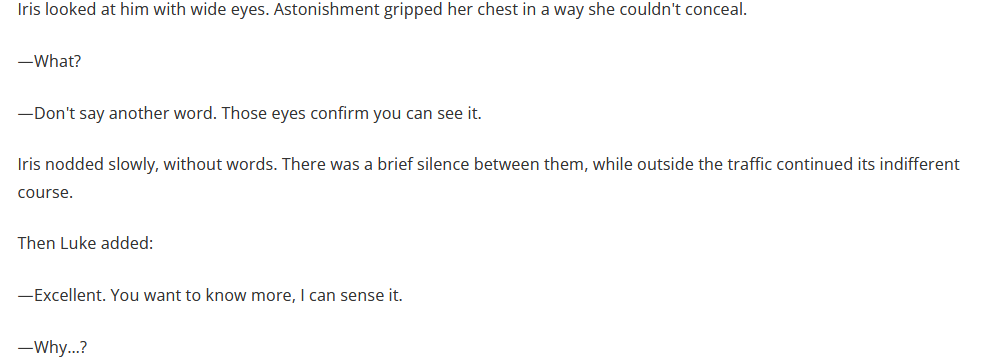
Then your have this section: "Iris looked at him with wide eyes. Astonishment gripped her chest in a way she couldn't conceal. —What? —Don't say another word. Those eyes confirm you can see it. Iris nodded slowly, without words. There was a brief silence between them, while outside the traffic continued its indifferent course. Then Luke added: —Excellent. You want to know more, I can sense it."
I get the gist. He's the first person to see the tower that is invisible to everyone else. Cool. Perfectly fine for the story. But you have this grand reveal that should mean a lot. Both to the protagonist and to the reader. This should be a major moment. But you don't give it time. Iris isn't stewing inwardly at what all this could mean. There's little physical reaction. Just a very abbreviated and rushed through. "You see the tower too? Sh ... don't tell anyone. Someone could be listening. Excellent. You want to know more, I can sense it"
As an added note, this last sentence is not how any normal human talks. "Excellent. You want to know more, I can sense it" is how villain Yoda speaks while twirling his mustache and tying Luke Skywalker to the train tracks. It's also emblematic of the entire problem with your scenes. It's exposition that shortcuts any normal human reaction. Like, for example, you actually having to show Iris begging to know more. Luke becoming genuinely excited about someone else finally seeing the tower, but forcing himself to keep his excitement to himself so that nobody overhears. Instead, Luke reads Iris's mind to just hurry the scene along. And because you as the writer seem bored by this scene and just want to speed it up, the reader also feels bored by it. When it should really be an establishing scene for the whole story.
You finally slow down in the next scene. And it's almost really touching and emotional. Because you are focusing on details, giving the characters room to think, react, notice shit. But then you immediately undercut the tension with more exposition. "After his mother's death, everything had gotten much worse very quickly. The doctors talked about accelerated deterioration, neurological factors, expected progression. But Iris always had the feeling that something more had broken inside him. As if the loss had switched off something essential that doctors couldn't measure in any test"
You're trying to create mystery, to give context. But none of that matters to the reader yet. We cared enough through basic empathy. We didn't need a magical cause, a timeline, or anything else. We had shared humanity, empathy, and a reason to care about a protagonist who has rushed past every other scene that might have made her interesting.
Finally comes the last scene. But again, the tone is too distant and Iris doesn't react in any sort of believable human way. There is no sense of urgency actually conveyed. All the audience really sees is "imaginary tower now is in two, floating over the city". There's no urgency there. Nobody is dying. It's just ... a weird magical thing that has changed in an arbitrary way. Maybe actually have her under the tower when it happens? Cower in abject horror before realizing that it is falling slowly? Have people react to the crazy girl screaming over nothing? That would create the urgency you seem to want.
Ultimately, the setting is cool. You've got good ideas. But you need to actually take your time building them, and do it properly. Let your originality actually shine in your ideas and your characters. Not by skirting the process of actually writing your scenes, building paragraphs with rhythm, and punctuating your dialogue properly.
First issue, you need to choose a narration style. You open in the third-person but then immediately swap over to first-person narration in italics. You kind of need to pick one narrator (either the invisible one floating over the room, or the protagonist). Because all the switching gives tonal whiplash.
If you choose a third-person narrator, then you need to work on making the protagonist's inner dialogue a bit less stilted. When you read someone's thoughts, they're not supposed to sound like they are trying to write a novel. Never have woken up thinking in the cadence of, "I'll admit it, my parents were a dysfunctional couple. I still remembered when my father would hit my mother… only for both of them, after everything, to end up crying in each other's arms. Despite all those incidents, they always made sure I wasn't around to see it. But how could I not hear it?"
Those aren't inner thoughts. They don't sound or feel like inner thoughts. They're literary narration.
Second, you need to cut a lot of exposition. Like: "It had started a few months ago. One day it simply… appeared. It was during a plane trip that she caught her first glimpse. The sun was hitting the windows and she was watching the clouds without thinking about anything in particular, when suddenly she saw it piercing through them from below upward, motionless and enormous. She almost had a heart attack thinking they were going to crash into it."
Show, don't tell. Either show us the event or let the information be filled naturally by the plot.
As you may be able to tell, I'm commenting as I read along. The aforementioned exposition suddenly turns into the full-on scene that you've already spoiled for us through the exposition. But my question is, if you're already going to show us how the tower appeared, then why isn't that the opening of the story? That would be a far better an opening hook than anything that came before it.
After that, we go back to more summarized exposition about some Luke guy. The exposition is a problem. But the bigger one is that you slip with no warning in and out of them. So I never really have a sense of whether weeks are passing, minutes, seconds. One minute, I'm being told something long ago, and the next minute I'm right back in the protagonist's thoughts. You have to think of this like a movie. You can't just jump all over the place, and expect the reader to enjoy being dragged around. You need to take your time, show the things that matter, give the protagonist room for their inner dialog.
-Hallelujah. Preach the good word, dear sibling in Satan.I started reading but couldn't keep going because the dialogue is marked by em dashes instead of quotation marks. Is there a reason for that? Why?
Then your have this section: "Iris looked at him with wide eyes. Astonishment gripped her chest in a way she couldn't conceal. —What? —Don't say another word. Those eyes confirm you can see it. Iris nodded slowly, without words. There was a brief silence between them, while outside the traffic continued its indifferent course. Then Luke added: —Excellent. You want to know more, I can sense it."
I get the gist. He's the first person to see the tower that is invisible to everyone else. Cool. Perfectly fine for the story. But you have this grand reveal that should mean a lot. Both to the protagonist and to the reader. This should be a major moment. But you don't give it time. Iris isn't stewing inwardly at what all this could mean. There's little physical reaction. Just a very abbreviated and rushed through. "You see the tower too? Sh ... don't tell anyone. Someone could be listening. Excellent. You want to know more, I can sense it"
As an added note, this last sentence is not how any normal human talks. "Excellent. You want to know more, I can sense it" is how villain Yoda speaks while twirling his mustache and tying Luke Skywalker to the train tracks. It's also emblematic of the entire problem with your scenes. It's exposition that shortcuts any normal human reaction. Like, for example, you actually having to show Iris begging to know more. Luke becoming genuinely excited about someone else finally seeing the tower, but forcing himself to keep his excitement to himself so that nobody overhears. Instead, Luke reads Iris's mind to just hurry the scene along. And because you as the writer seem bored by this scene and just want to speed it up, the reader also feels bored by it. When it should really be an establishing scene for the whole story.
You finally slow down in the next scene. And it's almost really touching and emotional. Because you are focusing on details, giving the characters room to think, react, notice shit. But then you immediately undercut the tension with more exposition. "After his mother's death, everything had gotten much worse very quickly. The doctors talked about accelerated deterioration, neurological factors, expected progression. But Iris always had the feeling that something more had broken inside him. As if the loss had switched off something essential that doctors couldn't measure in any test"
You're trying to create mystery, to give context. But none of that matters to the reader yet. We cared enough through basic empathy. We didn't need a magical cause, a timeline, or anything else. We had shared humanity, empathy, and a reason to care about a protagonist who has rushed past every other scene that might have made her interesting.
Finally comes the last scene. But again, the tone is too distant and Iris doesn't react in any sort of believable human way. There is no sense of urgency actually conveyed. All the audience really sees is "imaginary tower now is in two, floating over the city". There's no urgency there. Nobody is dying. It's just ... a weird magical thing that has changed in an arbitrary way. Maybe actually have her under the tower when it happens? Cower in abject horror before realizing that it is falling slowly? Have people react to the crazy girl screaming over nothing? That would create the urgency you seem to want.
Ultimately, the setting is cool. You've got good ideas. But you need to actually take your time building them, and do it properly. Let your originality actually shine in your ideas and your characters. Not by skirting the process of actually writing your scenes, building paragraphs with rhythm, and punctuating your dialogue properly.
I originally wrote it as a book, should I change the hyphens?I started reading but couldn't keep going because the dialogue is marked by em dashes instead of quotation marks. Is there a reason for that? Why?
I can't tell you how much I appreciate you taking the time to look at it. I'll try to improve on the points you mentioned.Okay ... so the title of this post was ... strange. But I respect the hustle of trying to rage people into useful feedback. Though it probably won't generate a lot of positive attention.
First issue, you need to choose a narration style. You open in the third-person but then immediately swap over to first-person narration in italics. You kind of need to pick one narrator (either the invisible one floating over the room, or the protagonist). Because all the switching gives tonal whiplash.
If you choose a third-person narrator, then you need to work on making the protagonist's inner dialogue a bit less stilted. When you read someone's thoughts, they're not supposed to sound like they are trying to write a novel. Never have woken up thinking in the cadence of, "I'll admit it, my parents were a dysfunctional couple. I still remembered when my father would hit my mother… only for both of them, after everything, to end up crying in each other's arms. Despite all those incidents, they always made sure I wasn't around to see it. But how could I not hear it?"
Those aren't inner thoughts. They don't sound or feel like inner thoughts. They're literary narration.
Second, you need to cut a lot of exposition. Like: "It had started a few months ago. One day it simply… appeared. It was during a plane trip that she caught her first glimpse. The sun was hitting the windows and she was watching the clouds without thinking about anything in particular, when suddenly she saw it piercing through them from below upward, motionless and enormous. She almost had a heart attack thinking they were going to crash into it."
Show, don't tell. Either show us the event or let the information be filled naturally by the plot.
As you may be able to tell, I'm commenting as I read along. The aforementioned exposition suddenly turns into the full-on scene that you've already spoiled for us through the exposition. But my question is, if you're already going to show us how the tower appeared, then why isn't that the opening of the story? That would be a far better an opening hook than anything that came before it.
After that, we go back to more summarized exposition about some Luke guy. The exposition is a problem. But the bigger one is that you slip with no warning in and out of them. So I never really have a sense of whether weeks are passing, minutes, seconds. One minute, I'm being told something long ago, and the next minute I'm right back in the protagonist's thoughts. You have to think of this like a movie. You can't just jump all over the place, and expect the reader to enjoy being dragged around. You need to take your time, show the things that matter, give the protagonist room for their inner dialog.
-Hallelujah. Preach the good word, dear sibling in Satan.
Then your have this section: "Iris looked at him with wide eyes. Astonishment gripped her chest in a way she couldn't conceal. —What? —Don't say another word. Those eyes confirm you can see it. Iris nodded slowly, without words. There was a brief silence between them, while outside the traffic continued its indifferent course. Then Luke added: —Excellent. You want to know more, I can sense it."
I get the gist. He's the first person to see the tower that is invisible to everyone else. Cool. Perfectly fine for the story. But you have this grand reveal that should mean a lot. Both to the protagonist and to the reader. This should be a major moment. But you don't give it time. Iris isn't stewing inwardly at what all this could mean. There's little physical reaction. Just a very abbreviated and rushed through. "You see the tower too? Sh ... don't tell anyone. Someone could be listening. Excellent. You want to know more, I can sense it"
As an added note, this last sentence is not how any normal human talks. "Excellent. You want to know more, I can sense it" is how villain Yoda speaks while twirling his mustache and tying Luke Skywalker to the train tracks. It's also emblematic of the entire problem with your scenes. It's exposition that shortcuts any normal human reaction. Like, for example, you actually having to show Iris begging to know more. Luke becoming genuinely excited about someone else finally seeing the tower, but forcing himself to keep his excitement to himself so that nobody overhears. Instead, Luke reads Iris's mind to just hurry the scene along. And because you as the writer seem bored by this scene and just want to speed it up, the reader also feels bored by it. When it should really be an establishing scene for the whole story.
You finally slow down in the next scene. And it's almost really touching and emotional. Because you are focusing on details, giving the characters room to think, react, notice shit. But then you immediately undercut the tension with more exposition. "After his mother's death, everything had gotten much worse very quickly. The doctors talked about accelerated deterioration, neurological factors, expected progression. But Iris always had the feeling that something more had broken inside him. As if the loss had switched off something essential that doctors couldn't measure in any test"
You're trying to create mystery, to give context. But none of that matters to the reader yet. We cared enough through basic empathy. We didn't need a magical cause, a timeline, or anything else. We had shared humanity, empathy, and a reason to care about a protagonist who has rushed past every other scene that might have made her interesting.
Finally comes the last scene. But again, the tone is too distant and Iris doesn't react in any sort of believable human way. There is no sense of urgency actually conveyed. All the audience really sees is "imaginary tower now is in two, floating over the city". There's no urgency there. Nobody is dying. It's just ... a weird magical thing that has changed in an arbitrary way. Maybe actually have her under the tower when it happens? Cower in abject horror before realizing that it is falling slowly? Have people react to the crazy girl screaming over nothing? That would create the urgency you seem to want.
Ultimately, the setting is cool. You've got good ideas. But you need to actually take your time building them, and do it properly. Let your originality actually shine in your ideas and your characters. Not by skirting the process of actually writing your scenes, building paragraphs with rhythm, and punctuating your dialogue properly.
I tried to keep it quick to get to the important parts, but it seems I need to make some corrections.
Sometimes it might sound strange, that's because English isn't my first language.
Thanks again! :D
Last edited:

FRWriter
Well-known member
- Joined
- Oct 3, 2024
- Messages
- 703
- Points
- 108
Have you read a single story here on SH?
Probably not.
If you had, you'd have noticed that your story seems like it was written by an Alien.
There is so much wrong with it that I really can't be bothered to go over everything.
But you write in a style I have NEVER seen more. Look, that's not how you write a story. Please pick a random story with 200-300 readers from SH and check how to create paragraphs, conversations, and narration. Check punctuation marks, check the overall form.
Probably not.
If you had, you'd have noticed that your story seems like it was written by an Alien.
There is so much wrong with it that I really can't be bothered to go over everything.
But you write in a style I have NEVER seen more. Look, that's not how you write a story. Please pick a random story with 200-300 readers from SH and check how to create paragraphs, conversations, and narration. Check punctuation marks, check the overall form.

Makimaam
Well-known member
- Joined
- Dec 17, 2025
- Messages
- 281
- Points
- 93
Em dashes for dialogue are generally seen when the authors are French or Polish. It is not exactly “alien,” as you claimed, but I agree that since this is published in English, using a non-English style will alienate readers.Have you read a single story here on SH?
Probably not.
If you had, you'd have noticed that your story seems like it was written by an Alien.
There is so much wrong with it that I really can't be bothered to go over everything.
But you write in a style I have NEVER seen more. Look, that's not how you write a story. Please pick a random story with 200-300 readers from SH and check how to create paragraphs, conversations, and narration. Check punctuation marks, check the overall form.
FRWriter
Well-known member
- Joined
- Oct 3, 2024
- Messages
- 703
- Points
- 108
Em dashes for dialogue are generally seen when the authors are French or Polish. It is not exactly “alien,” as you claimed, but I agree that since this is published in English, using a non-English style will alienate readers.
I am talking about doing the narration like this:
Narration:
EMPTY SPACE
-Conversation.
He announces who is saying something or how he or she is saying something, then ends the sentence. Leaves a space and then writes the dialogue.
It makes no sense. I have never seen something like that.
Is that also the standard in French/Polish? I don't believe so...
Makimaam
Well-known member
- Joined
- Dec 17, 2025
- Messages
- 281
- Points
- 93
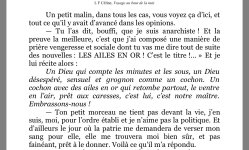
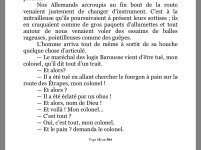
I wouldn’t say it’s non-standard in French. It is often seen in French lit (in the French edition). English translations generally reformat and attach the action directly to the dialogue instead of letting the dialogue float. That being said, while I understand why the OP did that, for general English readers it can be jarring to read. I have also seen many good works being rated poorly in SH due to non-conformity.Is that also the standard in French/Polish? I don't believe so...
Examples from Journey to the End of the Night
Attachments
-
 IMG_6964.jpeg282 KB · Views: 12
 -
 IMG_6965.jpeg244.5 KB · Views: 12

Well if it's French...What the fuck? Okay, I guess it's really done this way. This is so stupid. How confusing and chaotic can you craft conversations? Do you even know who's talking if it's done like that?