Don't need no stinkin' "SAID!"
Whoever started the rumor that the word '
Said' is invisible to the reader, is a Lying Liar that Lies. I notice
every single time that insufferable over-used loathsome filler-word excuse for a dialogue tag is used. In fact, I loathe all
dialogue tags inclusively.

I
don't need to use Said or any other Dialogue Tag because there is a far better option.
I use a Character's
Actions to define who is speaking to whom. I use ACTION TAGS.
What the heck is an Action Tag?
BODY LANGUAGE
Instead of TELLing your Readers how a character feels, SHOW how your characters really feel --even when their lying-- with ACTION TAGS!
“I love you too.” She rolled her eyes and sighed dramatically. “Oh yes, I truly do love you.”
“I love you too.” She dropped her chin and pouted. “Oh yes, I truly do love you.”
“I love you too.” She glared straight at him. “Oh yes, I truly do love you.”
“I love you too.” She turned away and wiped the tear from her cheek. “Oh yes, I truly do love you.”
"I love you too." She raised her balled fist and smiled with bared teeth. “Oh yes, I truly do love you.” She thrust up her middle finger.
 Dialogue is Visual
Not just a bunch of words.
Watch the average conversation between two people. 90% of that conversation isn't in what's Spoken, it's in what they are DOING while they are speaking. It's in their Body Language.
The
NONVERBAL THESAURUS
A Writer's Cheat-Sheet to
BODY LANGUAGE CUES
HOW TO USE: This is
list of
Facial Expressions and
body language used depending on the Emotion. Pick the Emotion your character is feeling. Add a few of the expressions and body language from that Emotion to Dialogue and Action scenes. This will SHOW those Emotions rather than simply Tell the Reader what the characters feel.
ANGER
Annoyance, Resentment, Rage
a. Jaws tensed to a biting position; “I’m going to bite you!”
b. Chest display, and/or hands-on-hips; “I’m bigger than you.”
c. Cut-off and head-jerk cues; “I don’t want that.”
d. Hand-behind-head. “I may or may not strike you.”
e. Fists, palm-down beating gestures. “I will strike you!”
f. Frowning and tense-mouth expressions; “Don’t make me bite you.”
g. Growling voice tones; “Consider me a threat.”
h. Staring; “I consider you a threat.”
I. Gaze avoidance; the head is turned fully away to one side; “Run while I am not looking and I will not attack you.”
(Cover of
Devil x Devil by Sachio Sawauchi)
DISGUST
Revulsion, Loathing, Nausea
a. Curled upper lip, a retracted upper lip, and mouth movements. "I feel like vomiting."
b. Digestive vocalizations of repugnance. Guttural sounds ("ach" or "ugh"); "I AM going to vomit!"
c. Narrowed or partly closed eyes; “Don’t make me look at that!”
d. Lowered brows of the frown face. "Ewww...gross!"
e. Backward head-jerks and side-to-side head-shakes. “Keep it away from my mouth.”
f. Visible protrusions of the tongue. “I can see that it tastes bad.”
(Art by ROYO)
FEAR
Anxiety, Apprehension, Dread
a. Angling body away; “Don’t touch me.”
b. Release of underarm scent; “Go away -- I stink!”
c. Increase in breathing rate. "I'm going to run away!"
d. Trembling and/or chattering teeth. "I want to run away!"
e. Crouching. “Don’t hurt me!”
f. Crying. “I’m hurt enough!”
g. Displacement gestures; “How did I get here?”
h. Fast eye-blink rate. “I don’t believe this!”
i. Fear grin. “I’m friendly! Honest!”
j. Widely opened flashbulb eyes. “I don’t believe this!”
k. Unconscious escape motions designed to remove a body part, or parts, from danger (e.g., flexing the neck to lower and protect the head). "Don't hit me!"
l. Freeze reactions; “Am I in danger?”
m. Hair-bristling; “I feel danger!”
n. Accelerated heart rate. "I'm getting ready to run away!"
o. Tightened shoulder muscle tension; “Do I need to flee?”
p. Screaming; “Don’t touch me!”
q. Squirm cues; “Let go of me.”
r. Staring eyes with dilated pupils; “How much danger am I in?”
s. Sweaty palms. "Too slippery to grasp."
t. Tense-mouth. “Don’t make me bite you.”
u. Throat-clearing. “I do not approve.”
v. Audibly tense tone-of-voice, either low and close to a growl, "I'm warning you..." or high to present a non-threatening sound. "I'm not a threat!"
w. Yawning. “No fangs, see? I’m not a predator!”
HAPPINESS
Contentment, Well-being, Joy
a. Laugh or smile
b. Crying; “I am overwhelmed.”
Unlike most other facial signs of emotion, the smile is subject to learning and conscious control. In the U.S., Japan, and many other societies, children are taught to smile on purpose, e.g., in a courteous greeting, whether or not they actually feel happy.
A true (i.e., involuntary) smile, crinkles the skin around the outside corners of our eyes, forming "crow's feet" or smiling eyes.
(Art by ROYO)
SADNESS
Sorrow, Unhappiness, Depression, Gloom
a. Bowing postures; “I’m terribly sorry.”
b. Cry face and lip-pout; “Please don't hurt me anymore.”
c. Gazing-down; “I am not a challenge.”
d. Slumped flexed-forward posture of the shoulders; “I give up.”
e. Audible sigh; “I give up.”
f. Compressed lips; “No, I don’t want that.”
The facial features constrict as if to seal-off contact with the outside world. In acute sadness, muscles of the throat constrict, repeated swallowing occurs, the eyes close tightly, and then tears.
(Art by ROYO)
UNCERTAINTY
Indecision, Misgiving, Doubt
a. Involuntary sideward eye movements; “Who is watching me?”
b. Self-touching gestures; “Am I still in one piece?”
c. Frown
d. Hand-behind-head; “I don’t think so…”
e. Side-to-side head-shakes “No.”
f. Sideward head-tilts; “I don’t want that…”
g. Lip-pout, lip-purse, and tense-mouth expressions “That tastes bad.”
h. Palm-up gestures; “I surrender.”
i. Shoulder-shrug; “Don’t touch me.”
Men tend to rub their chins with their hand, tug at the lobes of their ears, or rub their forehead or cheeks or back of the neck, in reaction to the increased tension. Male college students express uneasiness by changing their sitting posture to a more direct body orientation. “I’m going to to defend myself.”
Women will put a finger on their lower front teeth with the mouth slightly open or pose a finger under the chin. “I have no fangs, I am not a predator.” Female college students show uneasiness by sitting still and arm-crossing. “Dont touch me.”
(Art by ROYO)
SUBMISSION
Acknowledgment, Compliance, Surrender
a. Turning away “No thank you.”
b. body-bend, body-shift, and bowing “Please don’t…”
c. displacement cues “How did I get myself into this?”
d. facial flushing
e. freeze reactions “Am I in danger?”
f. gaze-down; “I am not a threat.”
g. give-way; “I will not challenge you.”
h. head-tilt-side; “Don’t…”
i. Mimic of superior’s body movements “I will not challenge you.”
j. laughing; “I will not challenge you.”
k. palms-up; “I surrender.”
l. exaggerated personal distance; “Don’t touch me.”
m. pigeon toes; “I can't chase you, I am not a threat.”
n. shoulder-shrugging; “Don’t touch me.”
o. shyness; “Don’t notice me.”
p. difficulty gazing directly at, or cross lines of sight with, a dominant individual. "I don't want to challenge you."
q. higher vocal pitch "I'm weak, and helpless."
r. yawning; “No fangs, see? I am not a threat.”
Note the considerable overlap between expressions of lower status (submission) and fear.
(Art by BROM)
DOMINANCE
Influence, Power, Control
a. Eyebrow raise; “Are you challenging me?”
b. Hands-on-hips posture; “I’m ready for battle.”
c. Head-tilt-back; “I dare you to bite me.”
d. Palm-down gesture; “Do I need to strike you?”
e. Swagger walk; “I’m stronger than you.”
f. Table-slap; “I will strike you!”
g. Lower tone of voice, close to a growl. "Don't make me bite you."
h. Wedge-shaped chest display; “I’m bigger than you.”
i. Direct stare; “I consider you a threat.”
j. Looming with chin down; “I will bite you.”
Aggressive behaviors include the head brought forward toward another person, chin out and pushed forward, wrinkled skin on the bridge of the nose, and a sharp movement of the head towards the other person, as though in preparation to bite.
The Business Suit
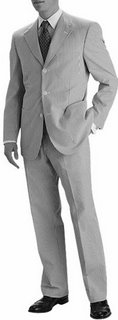
Built-in Dominance
The business suit allows a powerful, influential ‘wedge-like’ silhouette for business and public affairs.
Exaggerated chest display Strength cues are tailored into every Brooks Brothers® suit. The coat's squared shoulders exaggerate the size and strength of the upright torso. Flaring upward and outward, lapels enhance the illusion of primate pectoral strength. Dropped to fingertip level, the jacket's hemline visually enlarges the upper body to gorilla-like proportions. Pads and epaulets cover inadvertent shrugs and slips of the shoulder blades, to mask feelings of submission or uncertainty in the boardroom or on the battlefield.
(Art by ROYO)
LOVE
Affection, Devotion, Attachment
a. Physical contact, including hugs and kisses. "You belong to me."
b. Increased breathing rate; “I want to smell you.”
c. Courtship behavior; “I want to make love to you.”
d. Direct gaze with wide pupils; “I find you pleasing to look at.”
e. Facial flushing "You make my heart pound."
f. Head-tilt-side; “Are you looking at me?”
g. Increased heart rate "I am aware of you."
h. Mimic of behavior and/or appearance; “We make a set, we belong together.”
i. Softened tone of voice; “Come closer.”
j. Closing personal distance "I want to touch you."
For The Stages of
Courtship:
Go to:
[Tutorial] Making ROMANCE
Summary of Facial Expressions
1. Nose:
a) nostril flare (arousal)
2. Lips:
a) grin (happiness, friendship, contentment)
b) grimace (fear)
c) lip-compression (anger, emotion, frustration)
d) canine snarl (disgust)
e) lip-pout (sadness, submission, uncertainty)
f) lip-purse (disagree)
g) sneer (contempt)
3. Brows:
a) frown (anger, sadness, concentration)
b) brow-raise (intensity)
4. Tongue:
a) tongue-show (dislike, disagree)
5. Eyelids:
a) flashbulb eyes (surprise)
b) widened (excitement, surprise)
c) narrowed (threat, disagreement)
d) fast-blink (arousal)
e) normal-blink (relaxed)
6. Eyes:
a) big pupils (arousal, fight-or-flight)
b) small pupils (rest-and-digest)
c) direct-gaze (affiliate, threaten)
d) gaze cut-off (dislike, disagree)
e) gaze-down (submission, deception)
f) CLEMS
* (thought processing)
*CLEMS -- An acronym for "Conjugate Lateral Eye Movement." When the eyes move sideward (to the right or left) in response to a question. Rightward movement is associated with symbolic thinking, or Memory, (what we KNOW,) while Leftward Movement is associated with visual thinking, or Creativity, (what we INVENT).
In short: Right = TRUTH -- Left = FICTION (Lies)
~~~~~~~~~~~~~~~~~~~~
This information gleaned and paraphrased from the research by:
The Center for Nonverbal Studies (CNS).

~~~~~~~~~~~~
Want to read my other Writing tutorials?